Film Capacitors

Updated: Jun 11

Film capacitors are widely used because of their distinctive and advantageous electrical properties. They are available with many different dielectric materials, and this makes them suitable for a broad range of electronic and power electronic applications.
In general, film capacitors are commonly found in capacitance values from 100 pF to 100 µF. However, polypropylene film capacitors can extend this upper range significantly, reaching capacitance values up to several millifarads in some product families.
Film capacitors are non-polarized components. This makes them suitable for AC applications, but polarity is only one of the reasons why they are preferred in many circuit designs. Figure 1 shows several examples of film capacitors.
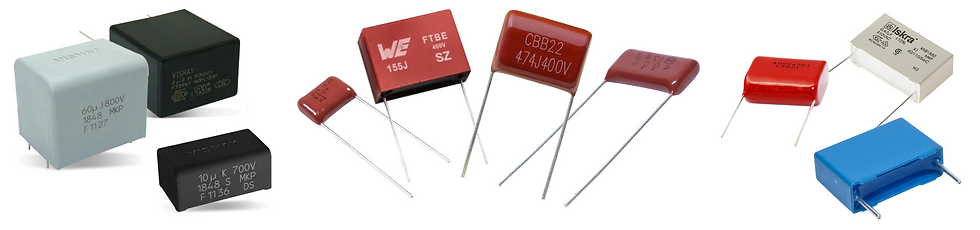
General Characteristics of Film Capacitors
Film capacitors can provide highly accurate capacitance values and can maintain these values for a long time compared with many other capacitor types. In general, their aging behavior is slower than electrolytic capacitors.
They also have a long shelf life, long service life and high reliability. Electrically, film capacitors can offer low ESR, low self-inductance and therefore a very low dissipation factor.
Film capacitors are available across a wide voltage range, from low-voltage types to high-voltage versions. Depending on the series and construction, they can be found in voltage ranges such as 10 VAC to 6 kVAC. They can also support high pulse current and high instantaneous current requirements.
However, these advantages come with some limitations. Compared with electrolytic capacitors of similar capacitance, film capacitors are generally larger. This also means that SMD package options are more limited. In addition, if they are forced to operate beyond their rated limits, they may fail severely and may even catch fire.
Power Film Capacitors
A special class of film capacitors is known as power film capacitors. These capacitors are designed to withstand reactive power levels above 200 VA.
Power film capacitors are used in higher-power applications where high current capability, reliability and mechanical robustness are important. In many cases, they are produced with screw terminals so that they can carry high current and be replaced more easily without soldering.
This makes them practical in power electronics, industrial systems, power factor correction units and DC-link applications.
Self-Healing Behavior
One important structural feature of many film capacitors is their self-healing capability.
During operation, small defects or local weak points may occur in the dielectric film due to electrical, thermal or mechanical stress. When this happens, the electric field may become concentrated around the damaged area.
If the voltage between the capacitor plates is high enough to create an arc in this local region, the arc vaporizes the damaged dielectric area and the nearby conductive electrode material. As a result, the local short-circuit path is removed.
This self-healing process helps prevent a permanent short circuit between the capacitor plates. It is one of the reasons why film capacitors are considered reliable in many applications, especially when they are used within their specified operating limits.
Dielectric Materials Used in Film Capacitors
Film capacitors use insulating plastic film as the dielectric material. Compared with many other capacitor families, the number of dielectric material variations is quite high.
Some of the most common film capacitor dielectric materials are:
polypropylene (PP),
polyethylene terephthalate (PET),
polyphenylene sulfide (PPS).
Each dielectric material has its own electrical, thermal and mechanical characteristics. For this reason, a film capacitor that performs very well in one application may not provide the same performance in another application.
For example, a capacitor suitable for pulse applications may not be the best choice for precision timing or high-temperature operation. Similarly, a capacitor selected for compact size may not provide the lowest possible loss or the best current capability.
Therefore, when selecting a film capacitor, the application recommendations and operating conditions given in the manufacturer’s datasheet should be reviewed carefully.
Common Uses of Film Capacitors
Film capacitors can be used in many different circuit functions. Some common use cases include:
general-purpose capacitor applications,
DC filtering and DC-link circuits,
power factor correction,
pulse applications,
RC snubber circuits,
RF and microwave applications.
Application Examples of Film Capacitors
Film capacitors are used in both high-power and low-power applications.
High-power examples include phase-shift circuits, X-ray flashing circuits and pulsed laser systems. In these applications, the capacitor may need to handle high voltage, high pulse current or rapid energy transfer.
Low-power examples include decoupling, filtering and analog-to-digital converter circuits. In these applications, the stable capacitance value, low losses and good frequency behavior of film capacitors can be useful.
Other application areas include electromagnetic interference suppression, fluorescent lamp ballasts and damping filters.
Film Capacitors in Snubber Circuits
Snubber circuits are used in many areas of electronics, especially in power electronics. They are commonly found in circuits such as flyback DC-DC converters and are used to suppress or limit voltage spikes caused by inductive loads.
In snubber circuits, the components must often have low self-inductance, low ESR and good pulse current capability. These requirements are important because snubber networks deal with fast voltage transitions and transient energy.
For this reason, polypropylene film capacitors are frequently preferred in snubber circuit designs. Their low losses, low dielectric absorption and good pulse performance make them suitable for this type of application.
Summary
Film capacitors are reliable, stable and high-performance components. They are especially useful when low ESR, low self-inductance, high pulse current capability and long service life are required.
However, they are usually larger than electrolytic capacitors with similar capacitance values, and they should not be operated outside their rated limits.
A simple summary table can be given as follows:
Parameter | Notes |
Capacitance range | Typically 100 pF to 4 mF depending on dielectric type and series |
Rated voltage range | Approximately 10 VAC to 6 kVAC depending on construction |
Advantages | High pulse current capability, low self-inductance, low ESR, high stability, low tolerance |
Disadvantages | Lower volumetric efficiency, larger size, limited SMD package options, sensitive to stress beyond rated limits |


